How much does a house cost in Cuba? Prices by zone and how to compare
Real price ranges by province and neighborhood, the factors that move them, and how to use real market data before buying, selling or renting.
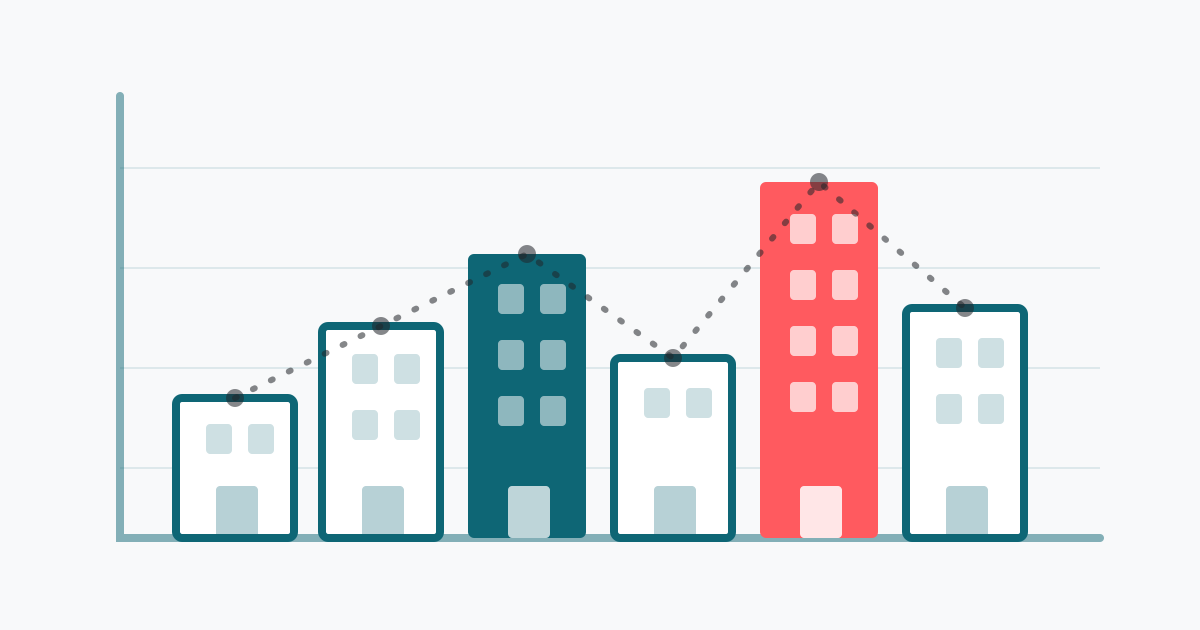
"How much is a house worth in Cuba?" is probably the most asked question in the Cuban real estate market — and the hardest to answer with a single number. There is no official price registry, no public appraisals, and the gap between a house in Old Havana and one in a provincial town can be enormous.
What does exist is the market itself: thousands of published listings with asking prices. Reading them well — by zone, by size, by currency — is the closest thing to an appraisal most buyers and sellers will ever have. This guide explains what prices look like today and how to compare properly.
The price map: Havana vs. the rest of the island
Havana concentrates the highest prices in the country, and inside Havana the differences are just as sharp. Municipalities like Playa and Plaza de la Revolución — with neighborhoods such as Miramar, Vedado or Kohly — sit at the top of the market, driven by demand from families abroad, renters and small businesses.
Central municipalities like Centro Habana or Habana Vieja mix high-value renovated homes with much cheaper properties needing full repair, so their averages hide a wide spread. Peripheral municipalities and most provincial capitals trade at a fraction of Havana prices, and small towns lower still.
The practical consequence: never judge a price without its zone. The same three-bedroom house can be worth several times more just by standing twenty minutes closer to the sea.
What moves the price of a Cuban home
Zone is the dominant factor, but not the only one. Number of bedrooms and bathrooms is the second-strongest signal — it is how most people search — followed by the state of the construction: a move-in-ready home commands a premium over one that "needs work", a phrase that can hide anything from painting to structural repairs.
Extras that matter in the Cuban context add real value: a garage, a cistern with reliable water supply, 220v wiring for air conditioning, terraces and independent entrances (useful for renting rooms). A legal status in order — clear title, updated property registry — is not an extra: without it, the price is theoretical.
Finally, the currency. Most sale listings are published in USD; a significant share is in CUP, especially outside Havana. Comparing a USD price against a CUP price without care is one of the most common mistakes — always compare within the same currency, or convert with the rate actually used on the street, not the official one.
Renting: a different market with its own logic
Monthly rents follow the same geography as sales — Havana first, tourist and business zones at the top — but with one twist: furnished homes in good condition can rent for amounts that seem high relative to their sale price, because supply of quality rentals is scarce.
If you are deciding between selling and renting out a property, compare the monthly rent average of your zone against sale prices: in high-demand zones, renting can be the better long-term option; in low-demand zones, selling usually is.
Use real data: CubanPortal's zone prices and calculator
To save you the manual work, CubanPortal computes market statistics directly from its active listings. On the home page you will find average sale and rent prices for any province, municipality or neighborhood — from a whole province down to a reparto like Vedado.
Next to it, the price calculator estimates what a property is worth: choose the zone, number of bedrooms and bathrooms, and whether you want to buy or rent, and it returns the median price of comparable listings, telling you how many real listings back the figure. The more comparables, the more reliable the estimate.
Use it before negotiating: if you are selling, it tells you what buyers in your zone are seeing; if you are buying, it tells you instantly whether an asking price is above or below its market.
What these numbers are — and what they are not
All figures come from asking prices of published listings, not from closed sales. Real transactions often close below the asking price after negotiation, and a zone with few listings produces less reliable averages.
Treat them as a compass, not a contract: they tell you the direction and the order of magnitude of your zone's market. For the final decision, combine them with visits, the state of the specific property and, in a sale, the advice of a notary.
How to value your own home in twenty minutes
You do not need an appraiser to arrive at a defensible figure. This is the method anyone with access to the listings and a little discipline would use.
- Filter by your municipality and, where it exists, your neighbourhood. Never compare against another zone.
- Filter by the same number of bedrooms and bathrooms as your home.
- Filter by the same currency: mixing USD and CUP invalidates any average.
- Discard the extremes: the most expensive and the cheapest listing are usually special cases.
- Take the median and adjust up or down for condition, water, garage and paperwork.
- Cross-check against the calculator, which runs this same computation over all active listings.
What adds and what subtracts, specifically
When adjusting your zone’s median, these are the features that move the price of a Cuban home the most, and in which direction.
| Feature | Effect |
|---|---|
| Registered title and up-to-date technical description | Adds: widens the pool of possible buyers |
| Private cistern with good supply | Adds, substantially, in areas with cuts |
| Sound 220v installation | Adds: air conditioning without building work |
| Garage or parking | Adds, especially in Havana |
| Independent entrance or ground floor | Adds: allows renting out or a small business |
| Roof not waterproofed for years | Subtracts: the most common and most expensive repair |
| Upper floor with no lift | Subtracts above the third floor |
| Unlegalised extension or barbacoa | Subtracts: the buyer discounts the paperwork and the risk |
| Unadjudicated inheritance | Subtracts heavily: most buyers will not even negotiate |
Frequently asked questions
- How much does a house cost in Cuba in 2026?
- There is no single figure: the range runs from modest homes in outlying municipalities or provincial towns to houses in Miramar worth more than twenty times as much. What is useful is not the national average but the average for your zone, which you can check by province, municipality and neighbourhood over the active listings.
- Why are some listings in USD and others in CUP?
- Because both currencies coexist in the market. Most sales are advertised in USD, especially in Havana, while a significant share of listings outside the capital are in CUP. Always compare within the same currency: converting at the official rate produces meaningless comparisons.
- Are listing prices the real sale prices?
- Not exactly. They are asking prices. Transactions usually close below them after negotiation, and there is no public registry of closed sales in Cuba that would let anyone measure that gap precisely.
- Is there an official home valuation in Cuba?
- For tax purposes there are minimum reference values set by the Ministry of Finance and Prices, which mark the lowest value that may be declared in a deed. They are not market prices nor an appraisal of your home: they exist to calculate tax, not to set an asking price.
Sources
- Resolution No. 313 of 2024 of the Ministry of Finance and Prices — minimum reference values of homes for tax purposes.
- Active listings published on CubanPortal — the basis for the per-zone averages.
Keep reading
Buying a house in Cuba from abroad: a guide for the diaspora
Cubans abroad and foreigners without residency: what the law allows today, how a purchase actually works and how to protect yourself from a distance.
Read guideThe Havana real estate market: a guide by municipality
From Miramar to Santos Suárez: what defines each area of Havana, what drives prices and where to search according to your budget.
Read guide